How do I create a discussion and manage content for my ministry?

On the Engage app, users can start conversations in a public community or a private community. All communities are available to users in the Connect tab of the Engage App.
A public community can be created by a ministry, inviting interaction and discussion from any users who wish to join and be a part of your community. A private community, on the other hand, can be created by a ministry or by an individual user, where membership is exclusive and can be accessed by invitation only.
To be able to create a public or private community for your ministry, each ministry should:
- Have an organization account (click here to learn more)
- Have created or claimed its own listing (click here to learn to create or claim a listing).
1. Login to your WayBase organization account.
2. Click on the Engage App tab, and click on 'Communities' in the left panel. Then click on the ‘+ Community’ button to create your first community.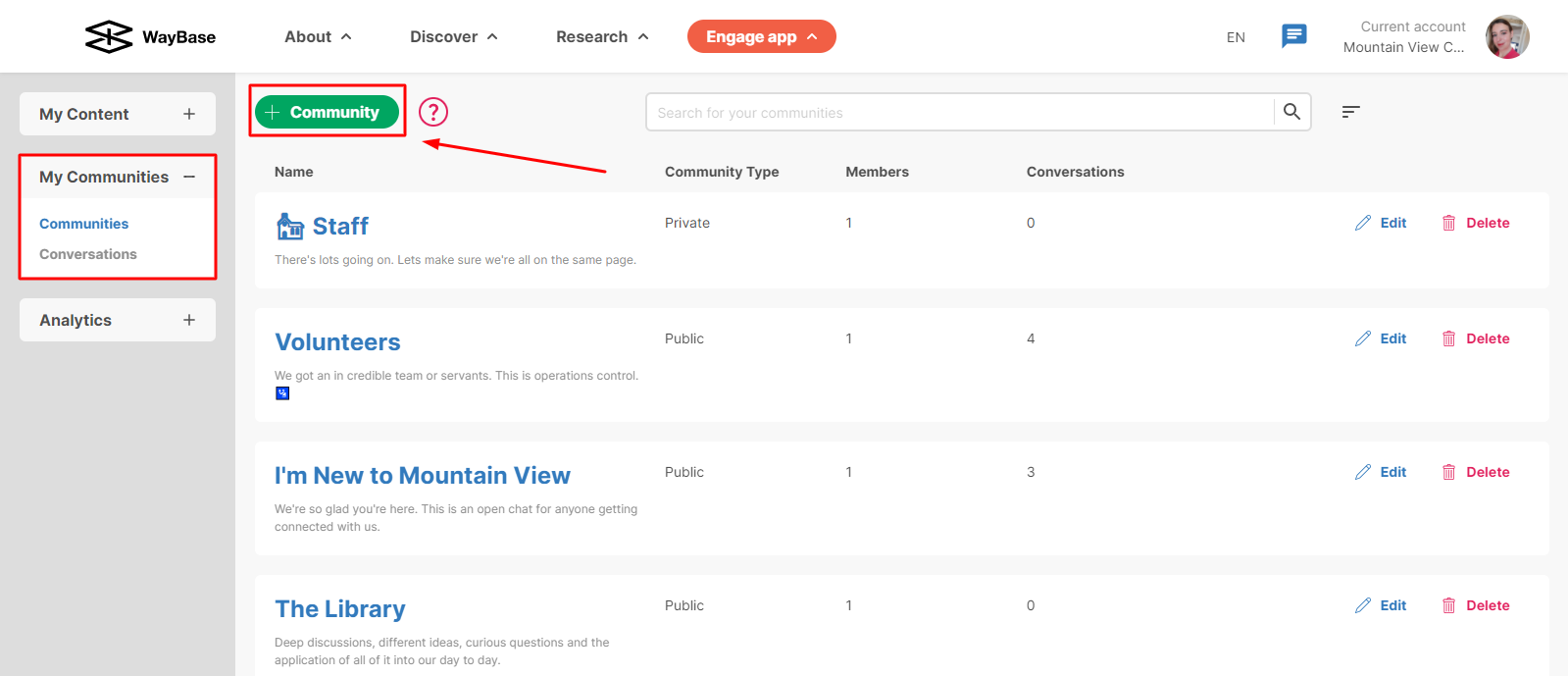
3. In the 'Details' section of the dialog box, you can enter the name and details that clearly indicate the purpose and identity of your community.
4. Here, you also have the option of making it public, available to all app users who find your community on the app, or private, where members are added to the community through invitation only.
5. Click on 'Listings' in the left panel of the dialog box, select your ministry listing, and click Save.
How do I manage my content on Engage?
1. On Engage App tab. Here, you will see all the content your organization has published on the app.
2. On the left panel, you will see the various content you can manage or edit, including content, communities, and analytics.
3. Under the ‘Content’ section, you can manage or edit items and distribution channels.
4. Under the ‘Communities’ section, you can manage your communities and conversations. While communities are overarching chat groups, conversations are specific chats within that community.
5. Lastly, in the ‘Analytics’ section, you can review how your community is engaging with the content your organization is creating for them. To learn more about how to understand the analytics, click here.